Confused about Central Bank Digital Currencies (CBDCs) and how they differ from Bitcoin? Discover what’s at stake for your privacy, freedom, and financial future, and why this battle matters more than ever in 2026.
Introduction: The Digital Currency Crossroads
Imagine waking up one morning to find your bank account replaced by a government-issued digital wallet, one that tracks every coffee purchase, donation, or cross-border transfer you make. Now imagine an alternative: a decentralized, borderless currency you truly own, with no middleman, no freeze button, and no expiration date.
Welcome to the new frontier of money.
As of early 2026, over 130 countries are exploring or piloting Central Bank Digital Currencies (CBDCs), digital versions of national fiat currencies issued and controlled by central banks. Meanwhile, Bitcoin, the original decentralized cryptocurrency, continues to gain institutional adoption, ETF approvals, and grassroots support as “digital gold” and a hedge against monetary instability.
But these two visions of digital money couldn’t be more different. And for everyday consumers, understanding the distinction isn’t just academic, it could shape your financial autonomy for decades to come.
In this deep-dive guide, we’ll break down:
- What CBDCs really are (and aren’t)
- How Bitcoin operates on fundamentally different principles
- Real-world implications for privacy, control, and economic freedom
- Actionable steps you can take today
Plus, we’ve included insights from economists, crypto advocates, and policy experts, and we want your take in the comments below.
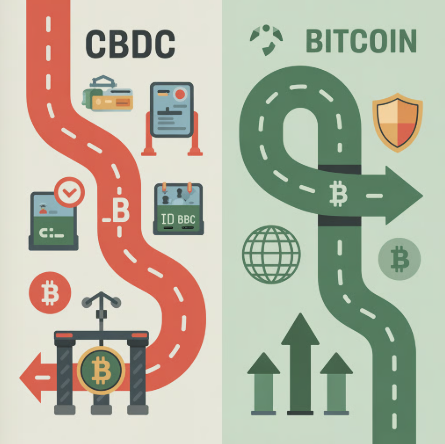
What Is a CBDC? Beyond the Buzzword
A Central Bank Digital Currency (CBDC) is a digital form of a country’s official currency, issued and regulated by its central bank. Unlike the digital dollars in your bank app, which are liabilities of commercial banks, a CBDC would be a direct liability of the central bank itself.
Think of it like digital cash, but programmable.
Key Features of CBDCs:
- Centralized control: Issued and monitored by governments.
- Programmability: Can include expiration dates, spending limits, or geo-fencing (e.g., “This $100 can only be spent on groceries before June 30”).
- Identity-linked: Tied to your legal identity via KYC/AML protocols.
- Real-time surveillance: Every transaction potentially visible to authorities.
Countries like China (with its Digital Yuan), Nigeria (eNaira), and the Bahamas (Sand Dollar) have already launched live CBDC pilots. The U.S. Federal Reserve, European Central Bank, and others are in advanced testing phases (Atlantic Council CBDC Tracker).
“CBDCs aren’t about innovation, they’re about control,” says Dr. Saifedean Ammous, economist and author of The Bitcoin Standard. “They digitize the existing monetary system but add layers of surveillance and restriction that physical cash never allowed.”
Bitcoin: The Decentralized Counterpoint
Bitcoin, launched in 2009 by the pseudonymous Satoshi Nakamoto, was designed as a response to the 2008 financial crisis, a trustless, censorship-resistant alternative to traditional finance.
Unlike CBDCs, Bitcoin has no central issuer, no governing body, and no backdoor access. Its rules are enforced by code and consensus across a global network of nodes.
Core Principles of Bitcoin:
- Decentralization: No single entity controls the network.
- Fixed supply: Only 21 million BTC will ever exist, immune to inflation by design.
- Permissionless: Anyone can send, receive, or verify transactions without approval.
- Pseudonymity: Transactions are tied to public keys, not personal identities (though not fully anonymous).
Bitcoin’s value proposition isn’t just investment, it’s sovereignty. As Michael Saylor, CEO of MicroStrategy, often states: “Bitcoin is a peaceful protest against monetary debasement.”

Head-to-Head: CBDCs vs. Bitcoin – A Consumer Comparison
| Feature | CBDC | Bitcoin |
|---|---|---|
| Issuer | Central bank (government) | Decentralized network |
| Control | Fully centralized | Fully decentralized |
| Supply | Unlimited (subject to policy) | Fixed at 21 million |
| Privacy | Low (KYC/AML enforced) | Pseudonymous (enhanced with tools like CoinJoin) |
| Censorship Resistance | None (transactions can be blocked/frozen) | High (once confirmed, irreversible) |
| Accessibility | Requires government ID & internet | Open to anyone with a device & connection |
| Programmability | Yes (spending conditions possible) | Limited (smart contracts via Layer 2) |
💡 Real-World Example: During Canada’s 2022 “Freedom Convoy” protests, banks froze donors’ accounts under government pressure. A CBDC could make such freezes instantaneous and universal. Bitcoin, by contrast, remained accessible to all participants, no permission required.
Why This Matters to You: 5 Consumer Implications
1. Financial Privacy Is at Stake
CBDCs could turn every transaction into a data point for governments or corporations. Want to donate to a controversial cause? Buy medication discreetly? With a CBDC, those choices may be flagged, or restricted.
Bitcoin offers greater privacy, especially when combined with best practices (e.g., using non-KYC exchanges, privacy wallets, or Lightning Network).
2. Your Money Could Expire or Be Restricted
Several CBDC pilots test “negative interest rates” or expiring balances to force spending during recessions. In theory, your digital dollars could vanish if not used quickly enough.
Bitcoin cannot be programmed to self-destruct. Once yours, always yours.
3. Cross-Border Freedom vs. Capital Controls
CBDCs may reinforce national borders. Sending Digital Dollars abroad could require approval, incur delays, or be blocked entirely.
Bitcoin moves globally in minutes, no gatekeepers, no forms.
4. Systemic Risk vs. Individual Custody
With CBDCs, your funds exist only as database entries controlled by the state. System failure, cyberattack, or policy shift could lock you out.
With Bitcoin, not your keys, not your coins. Self-custody puts you in control, but demands responsibility.
5. Inflation Protection vs. Monetary Policy Tool
CBDCs amplify central banks’ ability to manipulate money supply, potentially accelerating inflation. Bitcoin’s fixed supply makes it a natural hedge.
As inflation concerns persist post-pandemic, this distinction grows sharper.
Expert Voices: Diverging Perspectives
We reached out to thought leaders across the spectrum:
Dr. Eswar Prasad, Cornell Economist & Author of The Future of Money:
“CBDCs can enhance financial inclusion and payment efficiency. But robust privacy safeguards and legislative oversight are non-negotiable.”
Lyn Alden, Investment Strategist:
“Bitcoin is the only asset class that’s both scarce and apolitical. In an era of fiscal excess, that’s invaluable.”
Caitlin Long, CEO of Custodia Bank:
“Don’t confuse CBDCs with crypto. One is state-controlled surveillance tech, the other is open-source freedom tech.”

What Can You Do? A Practical Guide for Consumers
You don’t need to be a developer or financier to prepare. Here’s how to stay ahead:
- Educate Yourself
Read the whitepapers. Follow credible sources like CoinDesk, Bitcoin Magazine, and central bank publications. - Experiment Safely with Bitcoin
Start small: buy $10–$50 of BTC via a reputable exchange (e.g., Kraken, Coinbase). Transfer it to a self-custody wallet like Exodus or Sparrow. - Demand Transparency on CBDCs
Contact your representatives. Ask: Will CBDCs replace cash? Will they be mandatory? What privacy laws apply? - Diversify Your Holdings
Consider allocating a small percentage of savings to Bitcoin as a long-term hedge, not speculation. - Stay Skeptical of “Digital Dollar” Marketing
Terms like “convenient” or “secure” often mask trade-offs in freedom. Always ask: Who controls it? Who can stop me?
The Bigger Picture: Two Visions for the Future of Money
At its core, the CBDC vs. Bitcoin debate isn’t just technical, it’s philosophical.
- CBDCs represent the evolution of state-controlled money: efficient, traceable, and compliant, but vulnerable to abuse.
- Bitcoin represents a return to sound, neutral money: scarce, open, and resistant to coercion.
Which future do you want?
As nations accelerate CBDC rollouts in 2026, consumer awareness has never been more critical. The choices made in the next 2–3 years could determine whether digital money empowers individuals, or entrenches surveillance capitalism.
Those that Stay Informed, Stay Free
The rise of digital currencies isn’t a distant sci-fi scenario, it’s happening now. Whether you lean toward cautious optimism about CBDCs or full-throated advocacy for Bitcoin, one thing is clear: ignorance is not an option.
Your money is your speech. Your transactions are your choices. And in the digital age, those choices are increasingly legible to powerful institutions.
So learn. Question. Experiment. And most importantly, own your keys.
👉 What’s your take?
Are CBDCs a necessary upgrade, or a threat to financial freedom? Could Bitcoin coexist with state digital currencies? Share your thoughts in the comments below, and don’t forget to share this post with someone who needs to understand what’s coming.
Authoritative Sources & Further Reading:
- Atlantic Council CBDC Tracker
- Federal Reserve: Exploring a U.S. CBDC
- Nakamoto, S. (2008). Bitcoin: A Peer-to-Peer Electronic Cash System
- Ammous, S. (2018). The Bitcoin Standard: The Decentralized Alternative to Central Banking
- Bank for International Settlements (BIS) – CBDC Reports