
The advertisement looked flawless. A beloved celebrity endorsed a cryptocurrency platform with enthusiasm, their voice patterns perfect, their facial expressions natural. Within 48 hours, millions had seen it. There was just one problem: the celebrity had never agreed to appear in the ad. In fact, they’d never even heard of the product. Welcome to advertising in the age of deepfakes—where the line between reality and fabrication has never been more perilously thin.
As we navigate through 2025, the advertising industry stands at a crossroads. Deepfake technology—artificial intelligence capable of creating hyper-realistic but entirely fabricated video and audio content—has evolved from a novelty into a powerful tool that’s reshaping how brands communicate. But with this power comes a profound ethical responsibility that many advertisers are only beginning to grapple with.
This isn’t merely a technological challenge. It’s a trust crisis that threatens the very foundation of brand-consumer relationships. The question isn’t whether your brand will be affected by deepfakes—it’s whether you’ll be prepared when it happens.
Understanding the Deepfake Revolution: More Than Just Digital Trickery

Before we dive into ethical frameworks, let’s establish what we’re actually dealing with. Deepfakes use machine learning algorithms, particularly generative adversarial networks (GANs), to create synthetic media that’s increasingly indistinguishable from authentic content. These systems analyze thousands of images or hours of audio to learn how a person looks, moves, and speaks, then generate entirely new content that mimics these patterns with unsettling accuracy.
The technology’s sophistication has accelerated dramatically. What required specialized equipment and expertise just three years ago can now be accomplished with consumer-grade software and a decent laptop. The barriers to entry have collapsed, and with them, the controls that once limited who could create convincing fake content.
For advertisers, this presents both temptation and danger. The ability to create celebrity endorsements without expensive contracts, to show products in exotic locations without travel costs, or to personalize advertisements at scale sounds like a marketer’s dream. But when these capabilities are deployed without transparent disclosure, they become a marketer’s nightmare—one that can destroy brand credibility overnight.
The stakes extend beyond individual brands. When consumers can no longer trust what they see and hear in advertisements, the entire marketing ecosystem suffers. We’re witnessing the erosion of a fundamental assumption that has underpinned advertising since its inception: that what brands show us, while aspirational and sometimes exaggerated, is fundamentally rooted in reality.
The Trust Deficit: Why Authenticity Matters More Than Ever

Recent research paints a sobering picture of consumer sentiment. According to recent studies, approximately 39% of consumers reported trusting advertising in 2025, marking an improvement from previous years. However, trust in social media advertising remains particularly low, with just 22% of younger consumers and 12% of older consumers trusting social media advertisements amid concerns over scams and misinformation.
More troubling still, 88% of consumers trust word-of-mouth recommendations from people they know above all other forms of marketing. This trust deficit didn’t emerge in a vacuum. High-profile cases have sensitized consumers to the dangers of synthetic media. From political deepfakes that spread misinformation to unauthorized celebrity endorsements promoting dubious products, the misuse of this technology has made headlines repeatedly. Each scandal chips away at the public’s willingness to take advertising at face value.
Consider the financial implications. When a major beverage company was caught using AI-generated “customer testimonials” without disclosure in late 2024, the backlash was swift and severe. Social media erupted with accusations of deception, the company’s stock price dropped 8% in a single week, and the marketing executive responsible resigned under pressure. The cost of that ethical lapse? An estimated $40 million in lost market value, not to mention immeasurable damage to brand reputation.
But the story doesn’t end with cautionary tales. Some brands are charting a different course, one that embraces transparency and puts ethical considerations at the forefront of their AI strategy. These pioneers are discovering that honesty about synthetic content doesn’t diminish its effectiveness—it can actually enhance consumer trust and engagement. Research shows that 81% of consumers need to trust a brand before buying from it, and 87% of shoppers are willing to pay more for brands they trust.
The Ethical Framework: Five Pillars of Responsible Deepfake Advertising
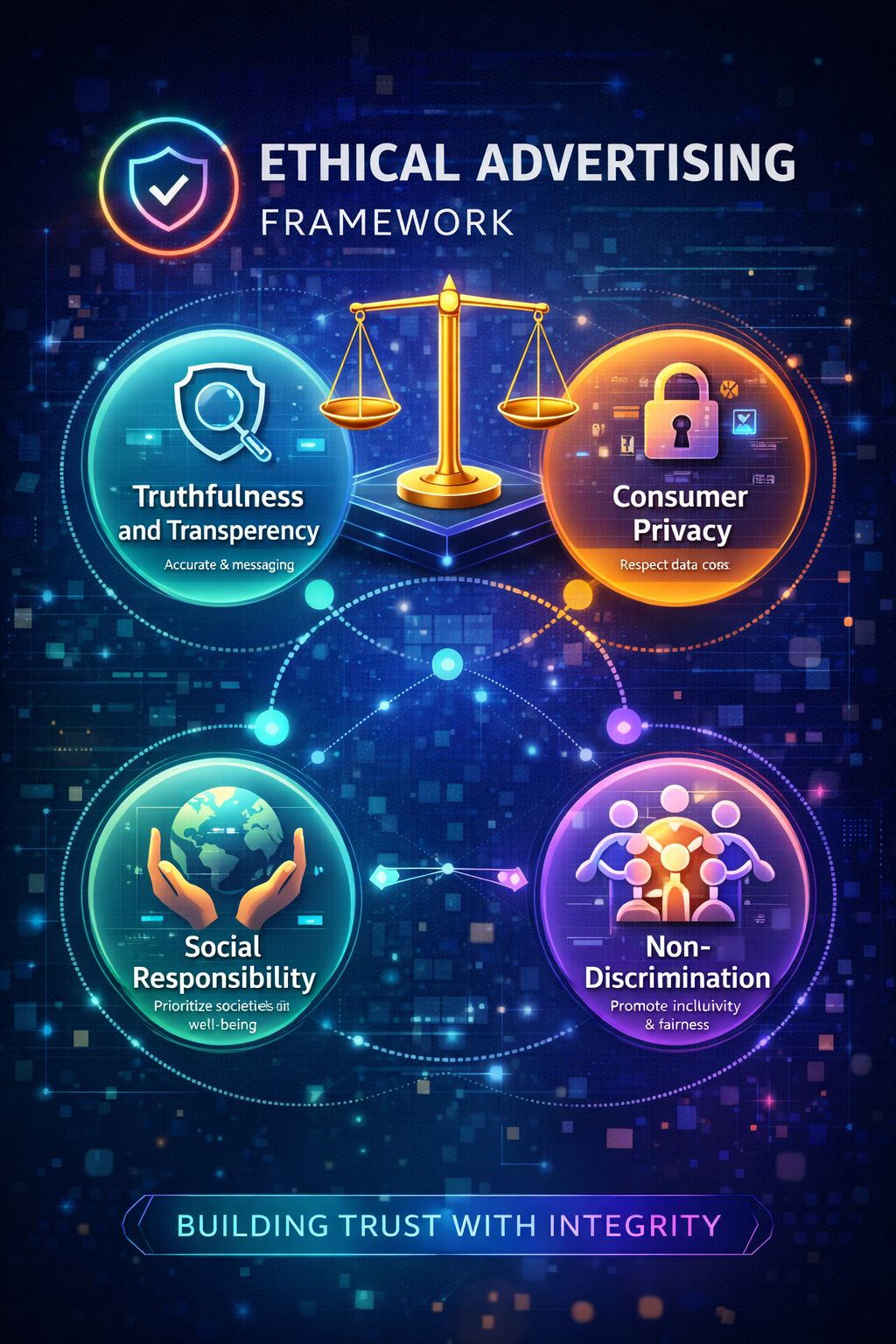
Building an ethical approach to AI-generated content in advertising requires more than good intentions. It demands a structured framework that can guide decision-making across organizations. Here are the five essential pillars that should anchor any brand’s approach to deepfake technology.
Transparency as a Non-Negotiable Standard
The first and most fundamental principle is radical transparency. If content is AI-generated or manipulated, consumers have an absolute right to know. This isn’t about small-print disclosures buried in terms and conditions. We’re talking about clear, prominent labeling that leaves no room for confusion.
What does effective transparency look like in practice? It means watermarks or labels that appear directly on synthetic content, not hidden in metadata that most consumers will never see. It means disclosure language that’s written in plain terms, avoiding technical jargon that obscures rather than clarifies. And it means treating transparency as an opportunity to educate and engage, not as a legal obligation to be minimized.
Some forward-thinking brands are going even further, creating behind-the-scenes content that shows how their AI-generated advertisements were made. This approach transforms a potential liability into a storytelling opportunity, inviting consumers into the creative process rather than hiding it from view.
Consent: Respecting Digital Identity Rights
The unauthorized use of someone’s likeness—whether they’re a celebrity, influencer, or everyday person—isn’t just ethically questionable. In many jurisdictions, it’s illegal, and the legal landscape is evolving rapidly to address deepfake-specific concerns.
According to research from the University of Arkansas, explicit consent from individuals whose likenesses are used to create deepfakes must be obtained, including informing them about how their images or voices will be used and the context for the content being created. Moreover, consent should be an ongoing process and not a one-time event.
The consent framework becomes more complex when dealing with deceased individuals or historical figures. While legal restrictions may be less stringent, ethical considerations remain paramount. Does using AI to resurrect a beloved actor for a commercial honor their legacy or exploit it? These questions don’t have easy answers, but they must be asked.
Accuracy and Context: The Obligation to Truth
Even when properly disclosed, AI-generated content carries an obligation to accuracy. Using deepfake technology to make false claims, misrepresent product capabilities, or create misleading contexts is fundamentally unethical, regardless of how transparently the content’s synthetic nature is disclosed.
This principle extends to ensuring that AI-generated endorsements reflect what the person would actually say or believe. If you’ve obtained consent to use a celebrity’s likeness, the content should still align with their known values, preferences, and past statements. Creating an AI version of an environmental activist endorsing fossil fuels, even with consent and disclosure, represents an ethical violation.
Context matters enormously. The same AI-generated content that might be acceptable in an obviously fantastical or humorous advertisement could be deeply problematic in a news-style format or testimonial setting. Brands must consider not just what they’re creating, but how audiences will interpret and understand it.
Accountability: Building Systems for Oversight
Ethical advertising with AI requires robust accountability mechanisms. This means establishing clear internal policies about when and how deepfake technology can be used, creating approval processes that involve diverse stakeholders including legal, ethics, and communications teams, and designating specific individuals who are responsible for ensuring compliance.
Many organizations are creating AI ethics committees or appointing chief ethics officers specifically to oversee these technologies. These aren’t ceremonial positions—they carry real authority to halt campaigns that don’t meet ethical standards, even when those campaigns have already consumed significant resources.
External accountability matters too. Brands should be prepared to respond quickly and transparently when questions arise about their use of synthetic media. This means having crisis communication plans specifically designed for deepfake-related controversies, including clear processes for verifying whether content attributed to your brand is authentic.
Societal Impact: Thinking Beyond the Campaign
The final pillar requires advertisers to consider the broader societal implications of normalizing deepfake content. Every advertisement that uses this technology—whether ethically or not—contributes to a larger ecosystem and sets precedents that extend beyond individual brands.
This means asking difficult questions. Is this campaign making it harder for people to distinguish truth from fiction? Does it contribute to cynicism about media more broadly? Does it create vulnerabilities that could be exploited by bad actors? These considerations might seem removed from traditional marketing concerns, but they’re increasingly relevant in an era where brand purpose and social responsibility drive consumer loyalty.
Some brands are taking proactive steps to offset potential negative societal impacts. This includes supporting media literacy initiatives, funding research into deepfake detection technologies, and participating in industry-wide standards development. These investments recognize that protecting the overall information ecosystem ultimately protects individual brands as well.
Industry Standards and Regulatory Landscape: Where We Stand

The advertising industry hasn’t been idle as deepfake technology has evolved. Several organizations have developed guidelines and standards, though implementation remains uneven and enforcement largely voluntary.
The Interactive Advertising Bureau (IAB) has been at the forefront of developing frameworks for AI in advertising. The IAB’s Legal Issues and Business Considerations When Using Generative AI in Digital Advertising provides comprehensive guidance on legal and ethical considerations. Their framework emphasizes disclosure, consent, and accuracy—pillars that align closely with the ethical framework outlined above.
Meanwhile, regulatory approaches vary significantly across jurisdictions:
United States: In May 2025, President Trump signed the TAKE IT DOWN Act, which criminalizes the nonconsensual publication of intimate visual depictions, including deepfakes, and requires online platforms to remove them within 48 hours if victims give them notice. State-level legislation is also advancing rapidly, with California, New York, Pennsylvania, and Washington enacting specific deepfake regulations.
European Union: The EU’s AI Act, which entered into force in 2024, includes specific provisions addressing deepfakes, requiring clear labeling of AI-generated content used for advertising, influence, or information. Penalties for noncompliance can reach up to €30 million or 6% of global revenue.
United Kingdom: The Online Safety Act 2023 and its 2025 amendments directly target creators of non-consensual sexually explicit deepfakes, with penalties of up to two years’ imprisonment.
France: Bill No. 675 proposes mandatory labeling of AI-generated or AI-altered images posted on social networks, with fines up to €3,750 for individuals and €50,000 for platforms.
These regulatory developments signal a clear direction: the days of the “Wild West” approach to deepfakes in advertising are numbered. Brands that wait for regulations to force their hand risk finding themselves on the wrong side of new laws, facing not just reputational damage but substantial legal liability.
Practical Implementation: Making Ethics Operational
Understanding ethical principles is one thing. Embedding them in daily operations is another. For marketing teams navigating the complex terrain of AI-generated content, practical implementation requires specific processes, tools, and cultural shifts.
Start with policy development. Your organization needs clear, written guidelines about when and how AI-generated content can be used in advertising. These policies should address the specific technologies your teams might use, from relatively simple voice synthesis to sophisticated video deepfakes. They should specify approval workflows, disclosure requirements, and consequences for violations.
Training is equally critical. Every member of your marketing team, from junior designers to senior strategists, needs to understand both the capabilities of deepfake technology and the ethical guardrails your organization has established. This isn’t a one-time orientation—it’s an ongoing education process that must evolve as the technology advances.
Consider implementing technology solutions that help maintain ethical standards. Several companies now offer tools that can watermark AI-generated content, track consent documentation, or detect undisclosed synthetic media in submitted advertisements. While technology can’t replace ethical judgment, it can support and scale human oversight.
Create diverse review teams for campaigns involving AI-generated content. Ethical blind spots often emerge from homogeneous groups with similar perspectives and incentives. Including voices from legal, communications, ethics, and diverse demographic backgrounds can help identify potential issues before they become public controversies.
Establish clear metrics for success that go beyond traditional performance indicators. How are you measuring consumer trust? What systems do you have for monitoring public reaction to AI-generated campaigns? Are you tracking long-term brand perception alongside short-term conversion metrics? These questions should inform how you evaluate campaigns that use deepfake technology.
Case Studies: Learning from Success and Failure
Real-world examples provide invaluable lessons for navigating this complex landscape. Let’s examine several cases that illustrate both the perils and possibilities of AI in advertising.
In early 2024, a major insurance company launched a campaign featuring AI-generated scenarios showing how their coverage protected families in various emergency situations. The company prominently disclosed the AI-generated nature of the content, treating it as a feature rather than something to hide. They explained that using AI allowed them to show diverse scenarios without placing real families in stressful situations for filming. The campaign performed well, with focus groups reporting that the transparency actually increased their trust in the brand. The lesson? Disclosure doesn’t diminish effectiveness when thoughtfully executed.
Contrast this with a prominent fashion retailer that quietly replaced several human models with AI-generated ones in their online catalog, believing consumers wouldn’t notice or care. When investigative journalists exposed the practice, the backlash was immediate and severe. Consumers felt deceived, models’ unions protested, and the company eventually apologized and removed all AI-generated model images. The cost of this decision extended far beyond the immediate crisis—the company reported measurably lower brand trust scores for months afterward.
Instructive Automotive Examples
A particularly instructive example comes from the automotive industry. A car manufacturer created an AI-generated advertisement featuring a famous deceased racing driver apparently endorsing their new sports car. Despite obtaining permission from the driver’s estate and including disclosure about the AI generation, the campaign generated significant controversy. Many fans felt the ad disrespected the driver’s memory, while others questioned whether posthumous endorsements were ever appropriate. The company ultimately pulled the ad and issued an apology, learning that legal permission and technical disclosure don’t automatically confer ethical validity.
On the positive side, several entertainment brands have found creative ways to use AI technology while maintaining ethical standards. One streaming service created an AI-generated “director’s commentary” feature that synthesized various interviews and behind-the-scenes footage to create personalized explanations of film techniques. The feature was clearly labeled as AI-generated and didn’t claim to represent the director’s original words—instead, it was framed as an educational tool based on authentic source material. This approach garnered positive attention for innovation while avoiding deception.
The Role of Consumers: Educated Audiences as Partners
Ethical advertising in the age of deepfakes isn’t solely the responsibility of brands and marketers. Consumers have a critical role to play, and forward-thinking companies are recognizing that educating their audiences benefits everyone.
Media literacy—the ability to critically evaluate media messages and distinguish credible sources from questionable ones—has become an essential skill in the digital age. Brands can contribute to this literacy through their own transparency practices and by supporting educational initiatives that help consumers navigate an increasingly complex media landscape.
Some companies are going further, creating resources that help consumers understand how deepfakes work and how to spot them. These efforts might seem counterintuitive—why would a brand that might use AI-generated content help consumers detect it? But this approach builds trust and positions the brand as a responsible actor genuinely concerned with the broader information ecosystem.
Consumer advocacy also plays a crucial role. When audiences call out undisclosed or unethical uses of deepfake technology, they’re performing a valuable service by holding brands accountable. Rather than viewing such criticism as hostile, ethical brands welcome this feedback and use it to refine their practices.
The relationship between brands and consumers around AI-generated content works best as a partnership based on mutual respect and transparency. Consumers get honest, clearly labeled content that respects their intelligence and agency. Brands get to innovate with powerful new technologies while maintaining the trust that’s essential for long-term success.
Looking Forward: Preparing for an AI-Dominated Advertising Landscape
The trajectory is clear: AI-generated content will become increasingly prevalent in advertising. The technology will continue improving, becoming more accessible and affordable. Within a few years, the question won’t be whether to use AI in your advertising—it will be how to use it responsibly.
Several emerging trends deserve attention. Voice synthesis technology is advancing rapidly, raising new questions about audio deepfakes in radio advertising and podcasts. Real-time deepfake technology could enable personalized video advertisements that address consumers by name with synthesized celebrity voices. AI systems are becoming capable of generating entire advertising campaigns, from concept to execution, with minimal human input.
Each of these developments brings new ethical considerations. As the technology becomes more sophisticated and widespread, the responsibility to use it wisely becomes more pressing, not less. The brands that will thrive are those that establish ethical frameworks now, before they’re forced to do so by regulations or crises.
This means investing in the infrastructure for ethical AI use—not just the technology itself, but the policies, training, oversight mechanisms, and cultural values that ensure it’s deployed responsibly. It means being willing to forgo profitable opportunities that cross ethical lines, even when competitors might not exercise the same restraint.
It also means participating in broader industry conversations about standards and best practices. The challenges posed by deepfake technology are too large for any single brand to address alone. Collective action, through industry associations and multi-stakeholder initiatives, will be essential for establishing norms that protect consumers while preserving space for legitimate innovation.
Conclusion: The Choice Before Us
We stand at a pivotal moment for advertising. The same technologies that enable unprecedented creativity and personalization also threaten to undermine the trust that makes advertising possible. How the industry responds to this challenge will shape not just the future of marketing, but the broader information environment we all inhabit.
The ethical use of deepfakes in advertising isn’t about limiting innovation—it’s about directing innovation toward outcomes that benefit everyone. Transparency, consent, accuracy, accountability, and consideration of societal impact aren’t obstacles to effective marketing. They’re the foundation for sustainable marketing in an age when consumers are more skeptical and more empowered than ever before.
The brands that will succeed in this new landscape are those that recognize a fundamental truth: trust is the most valuable asset any brand possesses, and no technological capability is worth sacrificing it. By embracing ethical frameworks for AI-generated content, companies can harness the creative potential of these tools while maintaining and even strengthening their relationships with consumers.
The choice is ours to make. We can allow deepfake technology to become synonymous with deception and manipulation, accelerating the erosion of trust in advertising and media more broadly. Or we can demonstrate that powerful new capabilities can be deployed responsibly, with transparency and integrity at their core.
The age of deepfakes is here. The age of ethical advertising in response to this technology is just beginning. The question isn’t whether your brand will be affected—it’s which side of this divide you’ll be on when the history of this era is written. Choose wisely, act transparently, and remember that in an age of easy fabrication, authenticity becomes not just a value but a competitive advantage.
The future of advertising depends on the choices we make today. Let’s make ones we can be proud of.
Key Resources and Further Reading
Industry Guidelines
Regulatory Information
Research and Statistics
- Consumer Trust in Advertising Statistics 2025
- Brand Trust and Transparency Research
- Navigating Ethical and Regulatory Challenges in the Age of Deepfakes
News and Updates
About the Author: This article was researched and written by marketing professionals specializing in AI ethics and digital advertising compliance. For questions about implementing ethical AI practices in your organization, please consult with legal and ethics advisors familiar with your jurisdiction’s specific requirements.


