the Age of Technology; From Stone Axes to Silicon Chips
Human history is measured not just in years, but in materials that defined entire civilizations.
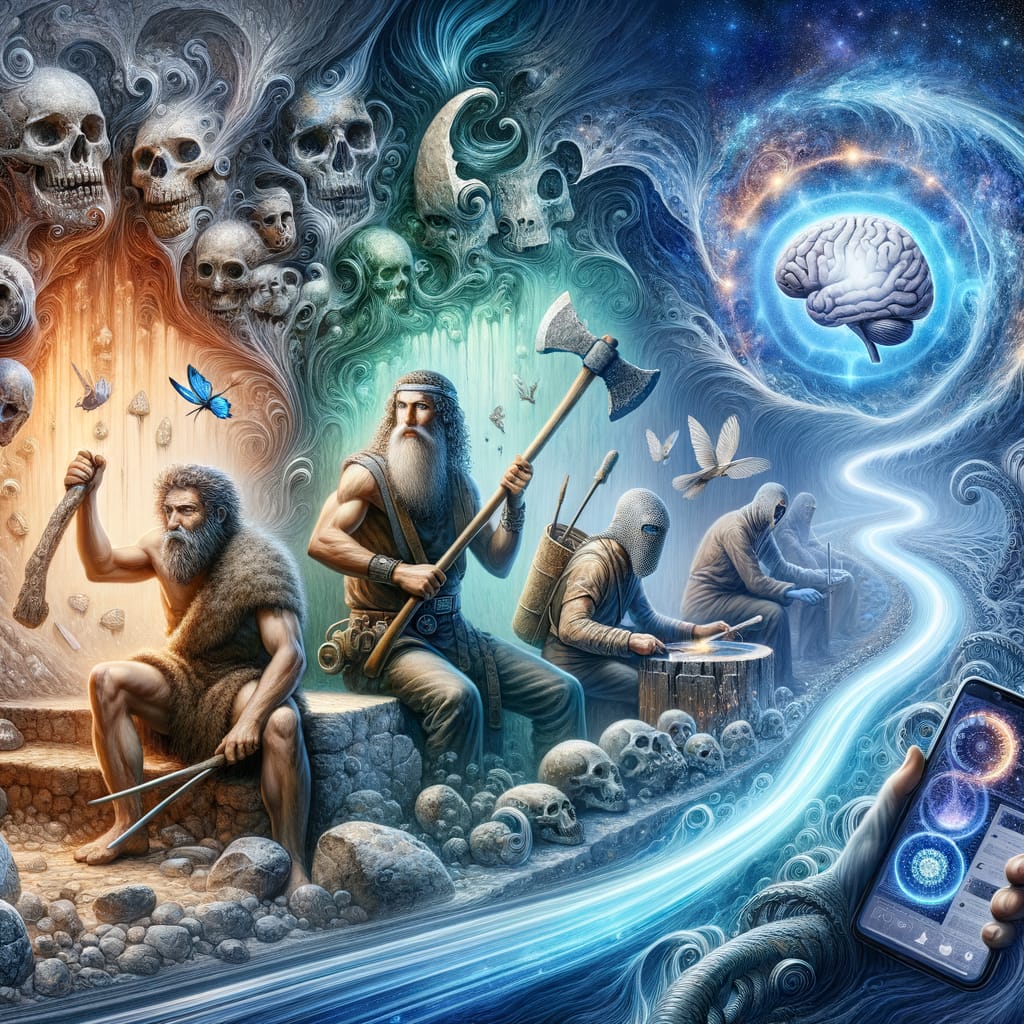
The Stone Age gave us tools for survival.
The Bronze Age brought trade, cities, and early writing.
The Iron Age forged empires with stronger weapons and infrastructure.
Today, we’ve entered a new epoch—not defined by metal or rock, but by data, algorithms, and connectivity. Welcome to the Age of Technology: the fastest, most transformative era in human history.
And unlike past ages that unfolded over millennia, this one is accelerating by the minute.
The Slow Burn of Early Innovation
For most of human existence, technological progress was glacial. It took 200,000 years to go from sharpened flint to the wheel. Another 3,000 years to move from bronze swords to iron plows.
But even then, change was local and slow. A farmer in 1000 BCE lived much like their great-great-grandparents—and their tools changed little across generations.
That began to shift during the Industrial Revolution (1760–1840). Steam engines, mechanized looms, and railroads turned weeks of labor into hours. For the first time, technology didn’t just assist humans—it multiplied human output.
Yet even this revolution unfolded over decades. The real explosion was still coming.
The Digital Big Bang: 1940s - 2000s
The true birth of our current age traces back to a single invention: the transistor (1947). Smaller than a fingernail, it replaced bulky vacuum tubes and made electronic computation possible.
From there, progress went vertical:
- 1951: First commercial computer (UNIVAC) weighed 16,000 lbs
- 1969: ARPANET—the internet’s ancestor—sent its first message
- 1971: Intel releases the first microprocessor (2,300 transistors)
- 1983: First mobile phone (Motorola DynaTAC)—cost $4,000
- 1991: World Wide Web goes public
- 2007: iPhone redefines personal computing
Moore’s Law held true: computing power doubled every 18–24 months. What once filled a room now fit in your pocket—and cost less than a pair of shoes.
This wasn’t just evolution. It was civilizational compression. Centuries of advancement were squeezed into a single human lifetime.

The Age of Technology: Defined by Speed, Access, and Intelligence
Unlike the Iron Age—which was named after it ended—we are living through the naming of our own era. And its hallmarks are clear:
🔹 Instant Global Connectivity
A fisherman in Indonesia can livestream his catch to buyers in Berlin. A student in Nairobi can take a Harvard course online. Distance no longer limits opportunity.
🔹 Democratized Creation
You don’t need a factory to build a business. With a laptop and internet, you can:
- Write and publish a book
- Design and sell digital art
- Launch an e-commerce store
- Automate customer service with AI
Tools once reserved for corporations are now free or low-cost for anyone.
🔹 Intelligence at Scale
Artificial intelligence analyzes medical scans, predicts market trends, and writes code. It’s not replacing humans—it’s amplifying them. And platforms like Galaxy AI Tools put this power directly in your hands.
🔹 Exponential Feedback Loops
Each breakthrough fuels the next. Better chips → faster AI → smarter robots → more efficient manufacturing → even better chips. This cycle has no off-ramp.
Why This Age Is Different and Full of Opportunity
Past technological ages favored kings, generals, and industrialists. The Age of Technology rewards the curious, the adaptable, and the self-directed.
Consider this:
- In the Stone Age, value came from physical strength.
- In the Iron Age, it came from land and armies.
- In the Industrial Age, it came from capital and factories.
- Today, value comes from knowledge, creativity, and access.
And access is no longer gatekept. Free tutorials, open-source software, and AI co-pilots mean you can learn high-income skills in weeks, not years.
At MadCashCentral, we see this daily. People using tech to:
- Earn passive income through affiliate marketing
- Build audiences on social media
- Automate side hustles with smart tools
- Protect their data with modern security practices
This isn’t “the future.” It’s now, and it’s available to anyone willing to engage.
Navigating the Risks: Not All Progress Is Equal
With speed comes risk. Misinformation spreads faster than truth. Algorithms can addict or manipulate. Automation threatens certain jobs.
But history shows: technology itself is neutral, it’s how we use it that matters.
That’s why curation, education, and ethical awareness are critical. At MadCashCentral Infopages, we don’t just report on tech, we vet, test, and explain which tools create real value versus hype. Because in an age of infinite noise, clarity is the ultimate currency.

Your Role in the Age of Technology
You don’t need to be an engineer or billionaire to thrive here. You just need to be intentional.
Ask yourself:
- What problems can I solve with today’s tools?
- What skills can I learn in 30 days that didn’t exist 10 years ago?
- How can I use connectivity to reach people who need what I offer?
The Stone Age didn’t end because we ran out of stones. It ended because better tools emerged, and those who adopted them led the next era.
Right now, you stand at the same threshold.
Will you watch the Age of Technology unfold… or will you build something inside it?
Explore trusted, tested resources on MadCashCentral Cash Content Curators, and turn insight into action.